Paint - Initial Research.

My chosen theme for term 1 of paint is 'The Urban Environment' and to begin my work for this I started with collecting together research from around Leicester looking at contrasting areas and different subject matter like city structures and crowds of people. I recorded my research in a sketchbook using different media; charcoal, pencil, photographs, ink and paint. As well as using different subject matter/ media I also paid attention to composition when producing my research ideas. To begin with I explored one of the the derelict areas of Leicester known as Frog Island looking at the ruined buildings and textures found within the damaged brick work. 


(Untitled, Pencil on paper, A5)


(Untitled, Ink on paper, A5)


(Untitled, Acrylic using pallet knife on paper, A5)

As well as looking at structures within the urban environment I have also looked at people. To record these ideas I used pencil in order to quickly draw the shapes and movement of the people as they walked through the town center.


(Untitled, Pencil on paper, A5)


(Untitled, Pencil on paper, A5)

I really enjoyed drawing the crowds of people, I like the movement created in my sketches due to my quick drawing technique used in order to capture the life of the people as they walk through the city. Within my sketches of people I have noticed that I seem to avoid facial features. However looking at the drawings I think this adds an interesting atmosphere to them as it makes the people appear anonymous, they are all strangers to one another but are all the equal as they go about their business in the city. 


(Untitled, Painting study on mdf, approx 10cm x 10cm)


 (Untitled, Collage using photograph and pencil, A5)


(Untitled, Quick continuous line drawing in pencil, A5)


After collecting together initial research I will continue on this, looking a contrasting elements within an urban environment. I will look to use different techniques and introduce more detailed paint techniques within my work relating to found artists that have particularly inspired me maybe due to their colour pallet, technique or even choice in subject matter. Plus I think I will consider developing on the concept of movement and life within my ideas because looking through my beginning research I think that the ideas that express some form of movement create a stronger atmosphere that is more appealing and engaging for the viewer compared to the ideas consisting of  a still structure. 

Visiting Artists - Stuart Cumberland.

Across the three years of the Fine Art Degree artists come in each term to present their work and life experiences in the industry to the students. These are a great part of the course as they show students what life is like after degree and how different artists work/ present their pieces. 

(November 1st) The first one of the year was the contemporary painter, Stuart Cumberland. He is greatly interested in Manhattan Art which is rather aggressive and mechanical. Cumberland uses block colours to express a lack of emotion and depth, making them appear extremely shallow. He based his pallet choice for his art work on the basic colours found across the internet. His paintings are always large in scale often using stencils and oil paint. His most recent exhibition was, at The Approach in London in 2011, in which he presented four pieces; '4 Circle Paintings'. As well as exhibiting his work in the UK he was also involved in an exhibition in Belgium. It was during this period that Cumberland was having a lot of success with his art selling a great deal of work. 

(Some paintings from the '4 Circle Paintings' exhibition)


(Andy Irons, 2011, Oil on linen, 195x160cm)


(Leslie Nielsen, 2011, Oil on linen, 195x160cm)


(Ingrid Pitt, 2011, Oil on linen, 195x160cm)
However his success came to a sudden stop in 2012 leading Cumberland to have a breakdown. So during this tough time he applied to a school in Rome in the hope to escape the troubles at home. After a successful application Cumberland went to Rome in the early moths of 2013. It was a new opportunity for him to become sociable once again after such a solitary career over the last few years. During this time he also raised the question 'What can a painting do that other things can't?'. 


(BW240, 2011, Oil on linen, 240x190cm)

Cumberland sees the studio as a  place to release his energy that he keeps stored inside of him. During his early works he was greatly interested in the Fort/Da theory; this explores the erasing of something, translated to English it means there and gone. His current influences are; Jasper Johns, Christopher Wool, Christopher Williams. He also commented on the fact that he finds it easy to make large paintings due to his large bodily gestures, he finds working on small paintings too difficult and confined. 


London Trip 23rd - 25th Oct.

As well as a trip to Frieze Art Fair, first years also go on a three day visit to London, during which you are required to visit galleries gaining primary artist research. 


On the first day of our visit we visited the Tate Modern, Bankside Gallery and also the Jerwood Gallery Drawing Prize Exhibition. As well as this we also saw a few sites on our way through the city and I took many pictures to help me with my projects. Each gallery had different artists to look at all of contrasting styles and specialisms, giving me a wide range of names to note down and research. At the Tate Modern I had the chance to see work by Monet, Picasso, Giacometti but also I got to see art work that I have researched previously on other projects like work by Gerhard Richter and Jackson Pollock. I loved seeing their work in the flesh, it gave me a real sense of the scale these artists work to and also the mark makings an textures used that you cannot quite appreciate in a photograph.


(Weeping Woman, 1937, oil on canvas, Pablo Picasso)


(Yellow Islands, 1952, oil on canvas, Jackson Pollock)


(The Cage painting no.2, 2006, oil on canvas, Gerhard Richter)

The next day was a busy day leaving early and getting back late to make sure we visited everywhere we wanted to. We visited three galleries I have never been to before; the Saatchi Gallery, the Serpentine Gallery and also the Haywood Gallery. Obviously, these galleries were very different compared to the galleries we looked in yesterday, no gallery is the same. But what really stood out to me was that the artwork within them felt a lot more contemporary and also it was extremely interesting to see how different work is curated and presented. I found the Saatchi Gallery particularly interesting to go around as it was full of modern art from sculpture to instillation. The current exhibition on at the Saatchi consisted of contemporary Ukrainian artists. I particularly liked the work by Oleksander Klymenko and Anatoliy Kryvolap. Both painters, I found there use of colour and choice in composition very interesting and eye catching. However they are completely different from one another as Klymenko uses a great deal of colour and textures where as Kryvolap uses simple colour and minimal texture. 


(Glorification of the divine presence, 2013 acrylic on canvas, Oleksandre Klymenko)


(Moon. Night, 2012-2013, oil on canvas, Anatoliy Kryvolap)

On the final day we visited Trafalgar Square and explored what that area had to offer. We visited the National Gallery which contains old art that is very iconic to its era, like the renaissance period for example. But whilst there we took the opportunity to look at the Michael Landy 'Saints Alive' exhibition. It was very odd, consisting of mechanical sculptures that expressed religious acts. This exhibition was not to my taste but it was interesting to see something different I wouldn't normally chose to go and see. As well as going to the world famous National Gallery, we also visited some smaller scale private galleries in The Royal Opera Arcade. We went inside La Galleria Pall Mall and The Stephen Wiltshire Gallery. These were interesting as they were a lot smaller compared to the galleries visited over the previous two days. I particularly liked the work by Stephen Wiltlshire his intricate drawings of the city of London were beautiful to look at expressing an excellent skill. I also liked the work by Alaide Tobini and Isa Levy; I found there use of brush marks and shapes particularly inspiring as I love to use eye catching strokes of colour in my work. Finally walking towards Buckingham Palace we quickly went inside the ICA which is located along the Mall. The art work in here consisted of large installations and floor artwork. Not to my liking but again was very contrasting to other galleries I have visited. 


(Autumn, mixed media with encaustic on canvas, Alaide Tobini)


(Blue Door, oil and vinyle on canvas, Isa Levy)

Over the three days I explored many galleries seeing a huge variety of different art some that I loved and some that I did not fully understand but then everyone views art differently each piece raising different questions and answers for everyone. 

The Studio.

In CPS we were asked to get into groups of 4 or 5 and do some research into what a studio is and how it is used/ how we think it should be used and why they are important. 

This Oxford Dictionary definition for 'studio' is - a room where an artist, photographer, sculptor etc works - a place where films are produced, where musical or sound recordings are made, room where TV programs are broadcast/ recorded, a place where performers especially dancers practice etc, film or TV production company, studio flat.

Origin - it derives from the early 19th century Italian word studio and the Latin word studium/ studere meaning to study.

Why do artists need studio spaces - I think it important for an artist, sculptor, film maker etc to have some form of studio as a way of escapism from their normal surroundings and also as creative environment to produce their work in. Some people may need a lot of space for machinery, camera equipment or space in general to perform in like a dancer, they would not be able to practice well in a small confined space.

How a studio should be used during studies - I believe a studio space should be used to put up project work, to produce work/ put work together. When working in a shared studio space I think it is also very important that you consider those working around you and you should not make a mess to the extent that it would impact on other students. 

What is the role of peers? - Personally I see peers as very important when working in a shared studio space. You can feed off each others ideas, thoughts and inspirations. You can also access each others work constructively and positively saying what is working well and what isn't. The only negative sides to sharing a studio are that some people may not respect those around them and they may also 'steel' ideas. They may also accidentally damage others work if they are a messy artist which can be very frustrating even it wasn't intended. However overall I think sharing a studio with peers is important especially for evaluating each others work and giving each other encouragement. 

Organisations both local and national that offer studio space - 2 Queens Leicester; they offer a full space 2.5 x 5 for £65 per month, half a space 2.5 x 2.5 for £35 per month. Design Factory Leicester; newest studio spaces for professional artists and designers are offering spaces at £9 per sq ft. 
Wasp Studios Glasgow; 200 sq ft space at an average cost of £100-£150 per month
Wedo Space London; offer a huge space, 935 sq ft at £2,130
Acme Studios London; offer 300 sq ft space at  £256 per month. 

What are the benefits of working in a studio organisation with other -
Pros; feed off ideas, new friends/ connections, opportunity to do joint exhibitions, lively atmosphere.
Cons; some people may not be considerate to others, 'stealing' of ideas, may be too crowded/ noisy for some people. 

                                 (My studio space) 


Frieze Trip.


One of the trips for first years is a visit to the world famous Art Fair 'Frieze' in London. Its like the art worlds version of Fashion Week. Hundreds of galleries from around the world come together to one location to exhibit a huge variety of artists from painters and sculptures to unusual performance art. I have never been to Frieze or even heard about it before I started this course, so did not know what to expect and when we arrived I was amazed at how much art there is out there. It was so tiring walking around the fair all day as there was so much to get through but I didn't want to leave without seeing everything! It was a great chance to gain primary research noting down names of the artists who inspired me, but to also see different types of art I wouldn't normally consider when visiting exhibitions/ galleries like contemporary sculpture and performance art. Another thing I also loved was recognising work I have previously researched/ read about and also seeing turner prize winner Tracey Emin's work and the work of some of this years short list artists; Lynettee Yiadom-Boakye and David Shrigley. 

Afterwards I researched into some of the artists that really appealed to me. One of them was the Chinese fine artist Zhu Jinshi. His work particularly stood out to me due to his extremely thick use of oil paint on canvas and his application of large brush strokes which creates amazing textures. I did a little research into the work of Zhu Jinshi and I found out that his work represents traditional Chinese aesthetics, emphasising the harmony between human beings and the natural world. Also Jinshi uses traditional images that go on to represent reality depicted in the form of abstract art with completely free brush strokes. His paintings are images of 'the mind' and he believes that it is through the contact with materials that his perception of the world is expressed. 
(see his work below - Couriered Landscape, Oil on canvas 180 x 160 cm)

What is Art?

As a part of the Ba Fine Art course we have a module called CPS (Contextual and Professional Studies). We began this subject by bringing up the question 'What is Art?'. Our first task was to in pairs research this question and present our findings the following week. This question caused a discussion within the group about whether art does have a set meaning. 

To start with we looked at the dictionary definition of 'Art' :- "an expression or application of human creative skill and imagination typically in visual form producing works primarily for their beauty or power."  

We then went on to express our own opinions and I believe that art is the expression of ones self. It can express their thoughts, beliefs, memories, how they see things that happen around them and a whole variety of other things. Also art can be/ mean anything to anyone. Some people will love particular pieces of work that others may dislike. Also the original message/ meaning behind an artists work could be read as something completely different to the spectator. 

Art is open to all opinions. There is no right or wrong! 

Summer Project.

Before starting the course we were asked to conduct research into three different artists as an introduction to the contextual and professional studies unit; one from  the Turner Prize shortlist 2013, one from a gallery you visited over the summer and another one from an artist journal. 

Turner prize 2013 shortlist artist - Lynette Yiadom-Boakye

Born in 1977, Lynette Yiadom-Boakye is an artist currently shortlisted for the Turner Prize 2013. Yiadom-Boakye is based in London and she has shown her work in galleries across the world. She was nominated for her exhibition ‘Extracts and Verses’ at Chisenhale Gallery in 2012. Her work is traditional yet the subject matter is very innovative. Being a figurative painter the people in her work are not real but are familiar in terms of character expressing ideas that depict particular characters like revolutionists, fanatics, savages and missionaries. They are created from real life drawings and also memories, each painting showing a hidden story left open to the viewer’s own interpretation. Yiadom-Boakye’s pallet is very dark using warm browns and cooler tertiary grays that complement one another helping to generate a stronger more intense atmosphere for her subject matter. Her style is full of movement and texture which brings the characters to life heightening the hidden narrative behind each painting. This is what I particularly like about her artwork, the raw colours used help create a powerful atmosphere and story evoking the imagination of the viewer to give these people a story whether they are real or not.

Yiadom-Boakye’s work raises many questions for its viewer about how we read pictures, in particular, black subjects. Personally I think her paintings generate questions about race, politics and society. Her work goes beyond the galleries onto the streets of everyday life raisings many unanswered questions about society today. As well as current life issues her work also challenges the history of portraiture in art due to the absence of black subjects in the past along with their complete disappearance ever since portraiture became central to contemporary art.

In an interview with Jamie Stevens about her Chinsehale Exhibition in 2012 she comments that her paintings are translations of words, seeing them as paragraphs or sentences, with the hope they are read as stories with the suggestion of a narrative left open to the viewer. She also says the reason why she chose the name ‘Extracts and Verses’ for her 2012 exhibition was for a similar reason, that each painting is a piece of something else without providing the whole story. During this same interview Steven’s asked Yiadom-Boakye about the decisions taken when hanging the paintings for that particular exhibition. She says that she doesn't have much to do with the hanging of the paintings but always wants to be involved as she has a particular way of seeing. Also she creates so many paintings that there are so many meanings available. For this particular exhibition she comments on the fact she didn't want to depict her paintings like a community of men and women, but it was important to her that her paintings are hung in coherence to one another complementing each other in terms of tone, colour and form.


Yiadom-Boakye received great press for her work. In April 2012 the guardian wrote about her work. The headline of the piece was ‘Everyday actions are made poetic by Yiadom-Boakye's paint coaxed figures, emerging from her canvases with secrets intact.’ They comment about how she is one of life’s ‘great manipulators’ being able to depict character from bold textural strokes of paint. It is also said that her paintings are so compelling that it is difficult to believe that the characters in her paintings are not real. Yiadom-Boakye has put black subjects back into the soul of European painting.

(Paintings from ‘Extracts and Verses’ exhibition 2012)


Gallery visited over the summer - Convento de Santo Antonio, Loule, Algarve, Portugal Fernando Pinheiro's 2013 summer Exhibition - ‘La in Loule-al- ulya Pintura’

Fernando Pinheiro is a painter who lives in the Algarve in Portugal, as well as moving in between two major capital cities; Paris and Tokyo. Pinheiro’s work often expresses ideas influenced from his surroundings that influence his day to day life like people and their own memories. His work explores the theories behind the notion of modern art, his paintings in particular reflect on the fact that we are just a small spec in a large universe. As well as this his ideas also represent a generation showing images of war, immigration, debates and society.

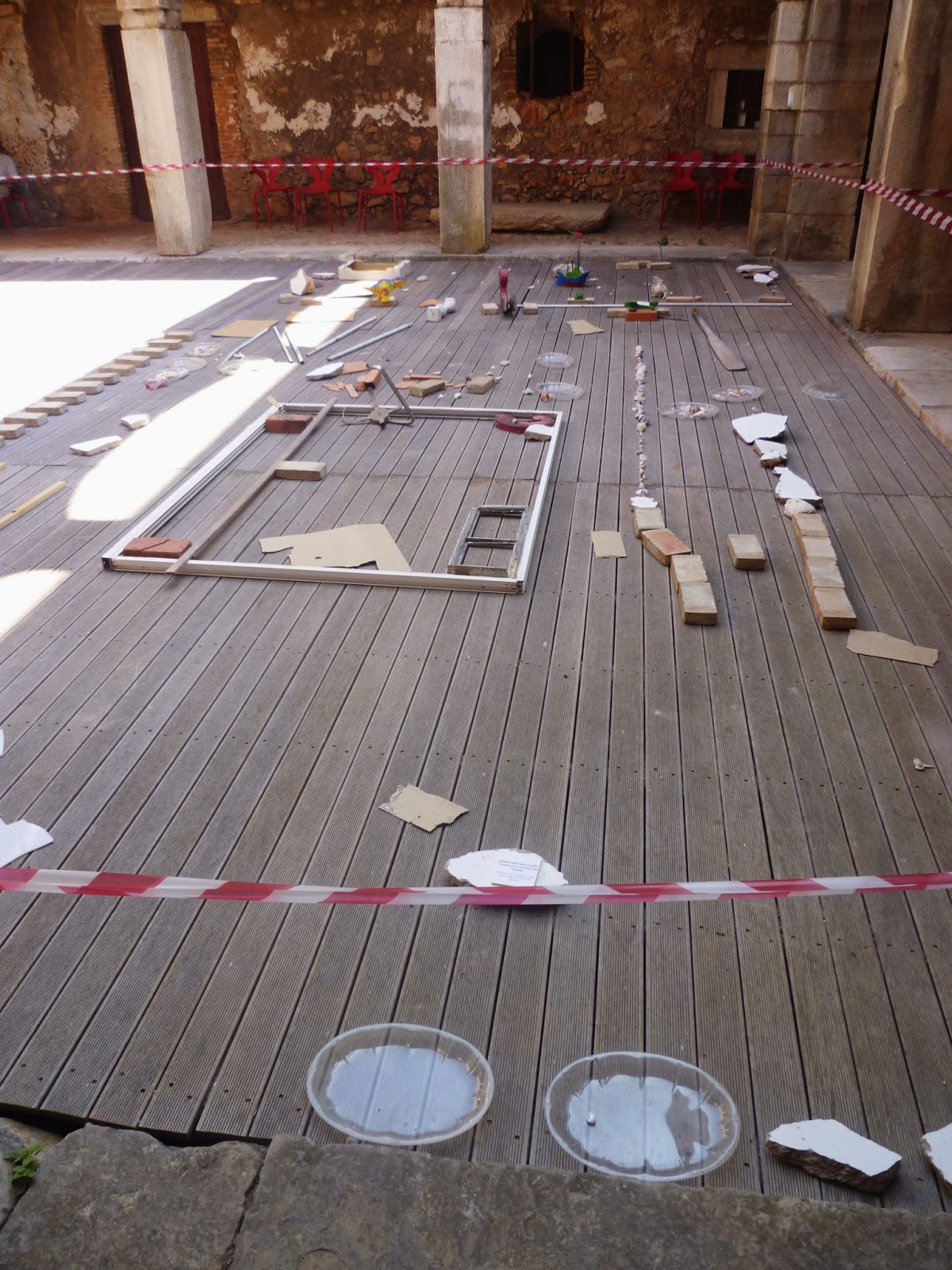
His 2013 summer exhibition of his work in a converted convent in Loule, Portugal shows a range of different billboards of work placed deliberately around the Loule council. They present both paintings and phrases together in china ink. During the mounting process of his exhibition he invited the general public to come and view this stage of work for a couple of weeks to involve everyone as a community. In an interview for a local Algarve magazine about his exhibition in Loule, Pinheiro says that he thought it would be interesting to transform the area into an artist’s workshop for those first two weeks creating a real environment to show the general people how an artist works. During the interview he also says how he did this to give people the opportunity to see his work as it progressed,  just like they would have centuries ago when artists would paint the churches. As well as paintings he also produced sculpture and installation work for his exhibition, one of them being a group sculpture produced by the general people and himself.

Pinheiro is an artist that doesn’t like to work alone; he prefers to be surrounded by people because it is their stories and experiences that really inspire his work. In the same interview previously mention he quotes - “If you are too self-centred you hide yourself away; if not, you communicate with people and ideas start to grow, and they are no longer yours, they are universal and eventually important things start to happen”. I love this comment and I think Pinheiro represents himself a universal artist that can reach out to anyone from any country, city and background. His aim for this exhibition in Loule was to transform that small city into the centre of the world. His reason for this being that small cities are never considered as the ‘centre of the world’ and he wanted to challenge that conception. Pinheiro believes that if you have the right imagination and passion you have the ability to make where you are the centre of the world.

In each of Pinheiro’s paintings he always incorporates parts of flying transport; like helicopters, planes and spaceships. Another noticeable feature within his work that I personally noticed when at his exhibition in Loule was the way in which his paintings had been arranged. They were placed in positions where extremely large paintings were placed next to tiny pieces of work. His installations were also placed in particular positions acting like obstacles for the viewer as they made their way around the gallery space, forcing them to dodge out of the way of things that had come away from the main sculpture.

(Work from his 2013 exhibition) 


Artist selected from a journal- Sarah Morris
Interviewed by ArtReview on her 2012 commission ‘Big Ben’ for Art on the Underground.

Sarah Morris is a British born contemporary artist who lives and works in New York but also works in London. She is a painter and film maker finding her inspiration from urban landscapes within some of the world’s major cities; New York, Chicago and Beijing, more closely looking at the architectural structures of these locations. She observes the unique characteristics of her chosen locations and often explores the relationship between ideas and the cities physical sounds and images. Some of her well known earlier work explores stained glass windows from cathedrals and intricate patterns found on Islamic mosques. Her paintings are very complex generating ideas about the experience of modern life. As well as her paintings her film work also explores urban themes often breaking down some major architectural components of a city to show their true form.

In her video interview for the art magazine ArtReview she explains the process in which her mind works, how she structures her work and what the viewer’s get out of it. Morris begins by commenting on how she produces her work often thinking in a series. This is then reflected on how she presents her work; the viewer can see that they are part of a bigger picture. She believes that this is what you experience when moving around in a, especially when in the underground or subway, you only see a flash of what you are passing. In this video interview she speaks specifically about her commission ‘Big Ben’ in 2012 produced for the Art of the Underground. She envisioned this particular work to be looked at whilst on the move rather than a billboard piece, in motion when travelling on the underground trains.

Some people believe that Big Ben and the London Underground work together. However Morris believes them to be completely seperate. In the video interview she comments that Big Ben is like a marker, a marker for where you are in the city and also where you are in terms of your day. She goes on to say that this is because Big Ben has a long history of what happened around it but it fails to tell this. Morris’ commission ‘Big Ben’ in the underground tells the stories of both the past but also the imagined future. Morris wants this to be in the mind of the viewer when they admire her work. Along with the hidden meanings behind her work, Morris’ idea of placing her pieces in the underground was also to make the paintings look like an animated film; they flicker as you travel on the trains showing them come together and come apart. Morris goes on to say that this is in fact the process of how she produces her work as well as the way things happen in cities. When creating her work Morris often looks at the networks within cities and this was why she was drawn to doing a piece for the underground; she thinks the structure of its map is beautiful. People comment on her work saying that they looks like maps but in the video interview she reveals that she has never used maps but that her works act like a virtual map to her brain linking politics, entertainment and society together. She believes that as an artist it is impossible to avoid this.

In a way Morris’ paintings remind me of the Piet Mondrian’s work, like his work her paintings use lines and colour to generate structural forms with depth and movement.  Looking at Morris’ paintings I can see the links and structures hidden within the abstract shapes. I can see the architectural references clearly and for me personally I do get a real sense of city life as the bright colours and lines within the paintings generate movement. 

(Pictures of her 'Big Ben' commission)